Historical Context
Development of the New Deal
Signing of the FLSA
Short Term Impact
Long Term Impact
Written Work
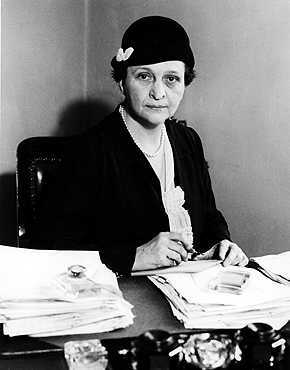
A photo of the Secretary of Labor, Frances Perkins
Frances Perkins, AP/Wide World Photos
The concept of a federal minimum wage law was proposed by workers’ rights advocate and Secretary of Labor Frances Perkins.
When Roosevelt asked Perkins to become the Secretary of Labor of the United States, she agreed under one condition; that he would allow her to advocate a law that would set a floor on wages, a ceiling on work hours, and a ban on child labor.
“I came to Washington to work for God, FDR, and the millions of forgotten, plain, common working men.”
- Frances Perkins, FDR's Secretary of Labor
"After many requests on my part the Congress passed a Fair Labor Standards Act, commonly called the Wages and Hours Bill. That Act—applying to products in interstate commerce-ends child labor, sets a floor below wages and a ceiling over hours of labor."
- Franklin D Roosevelt, quoted from his Fireside Chat on June 24th, 1938
On June 25th, 1938, President Franklin D. Roosevelt signed the Fair Labor Standards Act, establishing a federal minimum wage of ¢25 an hour, a maximum work week of 40 hours, overtime pay, recordkeeping, and provisions concerning child labor. Through the FLSA’s signing, Roosevelt fulfilled his responsibility of addressing long work hours, hazardous labor for children, and the need for a “living wage” for American workers.
It took a yearlong battle in the Supreme Court, but the FLSA finally won on Roosevelt’s third attempt. Many people, mainly employers of large businesses who would suffer from the passing of this act, were opposed to the idea of the FLSA, saying that it was "a badly written bill" and that it would lead to a horrid dictatorship. In the end, the act still passed with 72 amendments proposed.
"Do not let any calamity-howling executive with an income of $1,000 a day, ...tell you...that a wage of $11 a week is going to have a disastrous effect on all American industry."
- President Roosevelt, in his Fireside Chat (1937)
"Something has to be done about the elimination of child labor and long hours and starvation wages."
- President Roosevelt's response to a reporter's question
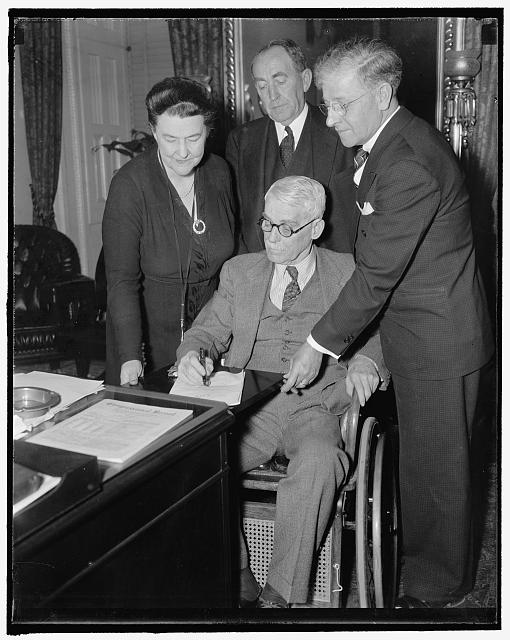
Texas Representative Joseph J. Mansfield, the last signature required for the FLSA to be brought to the floor of the House.
Joseph J. Mansfield, Mary T. Norton, etc., c. 1937, Library of Congress (2016872694)
"They prefer that he receives no wage at all unless he receives the same wages as paid by a large million-dollar factory. By their votes and their efforts, they are against all southern, western, and mid-western labor and industry, and favor monopolies and million-dollar corporations. They are against the farmers and the consumers likewise, because any aid to the large industrial corporations . . . and to their labor, will be at the expense of farmers and other laborers and consumers."
- Wade Kitchens, quoted from his speech against the FLSA, May 16th 1938